

Your retail or ecommerce company has grown and you’re ready to add some new technology. Maybe you have an ERP and are wondering what a data warehouse would add, or maybe your still shoping for that first piece and wondering which you need.
In either case, you might be surprised to learn that it isn’t a matter of “or” but of “both” and “when”! ERPs and data warehouses server very different functions, but can make awesome complimentary pieces with huge ROI when paired together.
ERP systems manage your daily operations like inventory, orders, and vendor management. Data warehouses, on the other hand, analyze past data to deliver insights that improve decision-making, KPI measurement, and forecasting.
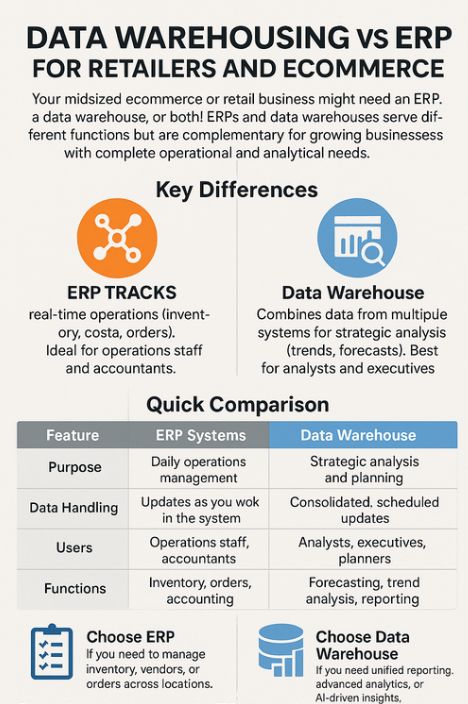
Key Differences
- ERP: Tracks real-time operations (inventory, costs, orders). Ideal for operations staff and accountants.
- Data Warehouse: Combines data from multiple systems for strategic analysis (trends, forecasts). Best for analysts and executives.
Quick Comparison
| Feature | ERP Systems | Data Warehouses |
|---|---|---|
| Purpose | Daily operations management | Strategic analysis and planning |
| Data Handling | Updates as you work in the systm | Consolidated, scheduled updates |
| Users | Operations staff, accountants | Analysts, executives, planners |
| Functions | Inventory, orders, accounting | Forecasting, trend analysis, reporting |
When to Use Each
- Choose ERP: If you need to manage inventory, vendors, or orders across locations.
- Choose Data Warehouse: If you need unified reporting, advanced analytics, or AI-driven insights.
For growing businesses, start with ERP for operations. Add a data warehouse as your data needs expand to unlock deeper insights and efficiencies.
What is a Data Warehouse & How Does it Work with ERP?
ERP vs Data Warehousing Basics
Let’s break down the roles and differences of these two systems to understand how they contribute to business growth.
ERP Systems Explained
ERP systems handle essential business processes like inventory, orders, accounting, and vendor management. They show the current status as you work in the system and make updates and often integrate with tools like POS and WMS to streamline SKU tracking, purchase orders, and order fulfillment.
Data Warehouses Explained
Data warehouses gather and combine data from various systems, including ERP, POS, ecommerce, and marketing platforms. Their main goal is to analyze past and current performance and provide insights for better decision-making, as well as power future forecasts and modeling with clean data for AI. According to OnePint.ai, AI-powered warehouses improve forecast accuracy by 15–23% and reduce fulfillment costs by 7–15%.
Main Differences Between Systems
Data warehouses act as a centralized hub for business metrics. By standardizing data from multiple sources like ERP, POS, ecommerce, and marketing platforms, they resolve issues like conflicting reports and inconsistent definitions. This unified approach allows analysts and executives to confidently base decisions on accurate, consistent data.
Understanding these distinctions helps you determine which system aligns better with your immediate business needs.
When to Use Each System
Choose an ERP system for managing daily operations, and turn to a data warehouse for detailed analysis and reporting.
Here’s how to determine which system fits your needs.
When an ERP System Makes Sense
An ERP system becomes essential when your business outgrows spreadsheets and simple tools. You’ll know it’s time to implement ERP if you’re dealing with challenges like:
- Managing multiple suppliers or vendors
- Tracking inventory across various locations
- Simplifying order fulfillment and back-office workflows
ERP systems consolidate your financial data, provide better cost visibility, and improve overall operational efficiency. However, when your reporting and analysis needs surpass what an ERP can handle, that’s where a data warehouse comes into play.
When a Data Warehouse Is the Right Choice
- Have sales, product, or customer data in more than one system
- Launching ecommerce or other omnichannel efforts
- Need to join marketing to sales, customer, product, or inventory data
- Struggling with inconsistent reports from different data sources
- Finding spreadsheet-based reports inadequate
With a data warehouse, you can gather data from multiple systems – ERP, POS, ecommerce platforms, marketing tools, and more – into a single repository. This setup ensures accurate, consistent analytics and gives you deeper insights into inventory patterns, operational performance, and areas for optimization.
How Business Growth Affects System Needs
Your technology requirements will shift as your business grows:
- Early stages: Start with a basic ERP to manage inventory and orders.
- Scaling up: Add a data warehouse to complement your ERP as your data needs expand.
- Mature business: Use both ERP and a data warehouse for advanced insights, including AI-driven inventory and marketing strategies.
sbb-itb-03d92ea
Using Both Systems Together
Now that we’ve covered the strengths of each system, let’s look at how ERP and data warehouses work together in practice.
ERP for Daily Operations
ERP serves as the backbone for everyday operations. It handles tasks like updating inventory and financial records in real time, triggering reorders, processing payments, and preparing shipping documents.
Data Warehouses for Business Insights
Modern data warehouses transform raw data into insights you can act on. By combining data from ERP, POS, and ecommerce systems, these warehouses help improve data availability, accuracy across systems, and time-to-report by cutting effort down from 8-40 hours of an analysts time, to 15 minutes for anyone on a functional team like marketing, ops, or merch. Then Data warehouse data views can be fed to your AI for results such as forecast accuracy by 15–23%, lower fulfillment costs by 7–15%, reduce stock-outs by up to 65%, and increase sales by as much as 11% with Inventory Management AI.
Benefits of Combining Both Systems
For mid-size retailers, integrating ERP with data warehouse systems provides a complete view of operations and trends. This combination supports AI-driven forecasting, better stock management, and more efficient supply chains.
Up next, we’ll dive into strategies designed specifically for mid-size retailers to implement these systems effectively.
Tips for Mid-Size Businesses
Mid-size retailers often face the challenge of managing limited budgets while meeting increasing data needs. Here’s how to focus your efforts effectively.
Tackling Common Challenges
First, pinpoint your main issue. Are manual order delays, complicated supply chains, or inventory management holding you back? If so, an ERP system can streamline operations. On the other hand, if you’re missing unified sales reports, consistent data, connecting scattered customer data, or accurate forecasting, a data warehouse might be the better starting point.
Retlia‘s Mid-Market Solutions

Unified Data Management
- Centralize all commerce data with a tailored retail / ecomm schema that integrates seamlessly with tools like Snowflake, Tableau, and other BI platforms.
Smart Analytics Tools
- Access real-time KPI dashboards, use drag-and-drop reporting, and gain AI-powered customer and marketing insights.
Effortless Implementation
- Self-service analytics provide instant insights, while integrated AI chatbots handle on-demand data queries.
Conclusion
ERP systems act like the nervous system of your business, while data warehouses serve as its brain. Both need to work in harmony for your operations to thrive.
Choosing between an ERP and a data warehouse isn’t an either-or decision for growing retailers and ecommerce businesses. Instead, it’s about understanding the role each plays and how they complement each other.
Key Takeaways
- ERP: Focuses on daily operations like inventory control, vendor management, cost tracking, and order and supply execution.
- Data Warehouse: Powers business intelligence, sales and margin analysis and analytics with unified data, advanced forecasting, marketing insights, and AI-ready capabilities.
When used together, ERP and data warehouses can improve act as the complete operational analytical toolset to grow your midsize ecommerce or retail business.
Next Steps
Use these points to determine which system aligns with your immediate needs:
Choose ERP First If You:
- Manage inventory across multiple locations
- Operate wholesale or physical retail businesses
- Need better tools for cost and inventory tracking
- Face challenges with vendor management
Focus on a Data Warehouse If You:
- Use multiple systems that require integration
- Need aligned executive KPIs like sales, margin, top products, top channels
- Seek deeper insights into customer behavior
- Plan to adopt AI for business improvements
- Need unified reporting across teams
To succeed, set clear goals and carefully evaluate which system fits your priorities.