

You do not need a bigger IT team to fix retail reporting. In this case, a mid-market retailer cut manual report work, removed IT wait time, and gave sales, marketing, inventory, and leadership direct access to data by putting ERP, CRM, ecommerce, inventory, and marketing data into one warehouse.
Here’s the short version:
- The problem: reports were stuck in IT queues or built by hand in spreadsheets
- The cost: one report could take 8 hours of staff time
- The shift: data moved into Snowflake through Matillion and into Tableau for self-service use
- The result: more teams could answer their own questions the same day
- The staffing impact: Nexus did this without hiring IT staff or in-house analysts
- The rollout: Retlia says its standard setup is ready in about 60 days
If I boil the story down to one point, it’s this: retail reporting breaks when data access depends on a small technical team. Nexus fixed that by changing the reporting model, not by adding headcount.
What stands out most is the business case. This was not about fancy dashboards. It was about stopping repeated manual work, cutting report delays, and giving non-technical users a way to work from one data source instead of scattered CSV files.
In plain English: if your team still spends hours pulling reports by hand, this article shows a simpler path – connect the source systems, centralize the data, and let business users get answers without opening another IT ticket.
How to automate insights with Tableau Data Stories
sbb-itb-03d92ea
Why Retail Reporting Breaks Down in Small and Mid-Size Teams
Nexus Outdoors already had ERP, ecommerce, inventory, and reporting needs pulling at the same team. But reporting requests still ended up waiting behind integration work. So people did what small and mid-size teams often do: they went back to CSVs and spreadsheets.
These common retail data problems are a pattern. IT teams are busy keeping data flowing between core systems, and reporting slips to the bottom of the backlog. Before long, the workaround becomes the process.
Manual Reporting Creates Delays, Errors, and Repeated Work
Manual reporting also leads to clashing metric definitions. When there’s no shared source of truth, teams waste time matching numbers instead of using them to decide what to do next. And once reporting becomes a reconciliation exercise, data stops being part of day-to-day decisions.
Nexus hit that same bottleneck. Even basic reports could get stuck behind more urgent IT work. Aaron Ambur described the point when it was obvious the setup had stopped making sense:
"My VP of Sales… said it would take one of his people eight hours… and I remember thinking, this report isn’t even that complex."
That kind of delay adds up fast. A report that should take minutes turns into half a workday, and then someone has to do it again the next week.
Most BI Setups Add Another Queue Instead of Removing One
Buying a reporting tool doesn’t fix this by itself. Many mid-size retailers still need technical help to model data, keep connections working, or answer questions that fall outside standard dashboards. So the tool is there, but the queue is still there too. Business users keep waiting for answers that should be immediate.
That was the pressure Nexus faced before it chose a self-service warehouse model. It fixed the access problem by automating it, without adding IT or analyst headcount.
Nexus Outdoors Had Enterprise Reporting Demands Without Enterprise Headcount
Nexus Outdoors is a mid-market retailer. But the reporting pressure it dealt with each day looked more like something you’d expect at a much bigger company.
Raw Data Wasn’t the Problem
For Nexus, the issue wasn’t just slow reporting. The business had simply outgrown manual access to data. Collecting data wasn’t the hard part. The hard part was turning that data into decisions.
Mid-Market Headcount, Enterprise Expectations
That gap kept getting wider because Nexus was expected to run like a much larger retailer.
"We have the same demands as a four billion dollar company."
Pressure like that is tough to handle when every new reporting need seems to call for more people.
Manual Reporting Made the Business Case for Change
Once reporting started eating up entire workdays, the conversation changed. It was no longer only about speed. It was also about cost. The delay made the price of manual reporting too obvious to ignore. And it pushed a bigger concern to the surface: could a company the size of Nexus even afford a data warehouse?
"I was very concerned… can a company of our size afford data warehouse implementation?"
What happened next was bigger than Aaron expected:
"Pleasantly surprised… the analytics we are afforded today rival what I was used to in the big company I left."
Nexus showed that a mid-market retailer can deliver enterprise-grade reporting without adding analysts or IT staff. That pressure led straight to the next move: automating reporting without hiring IT or analysts.
How Nexus Outdoors Automated Reporting Without Hiring IT or Analysts
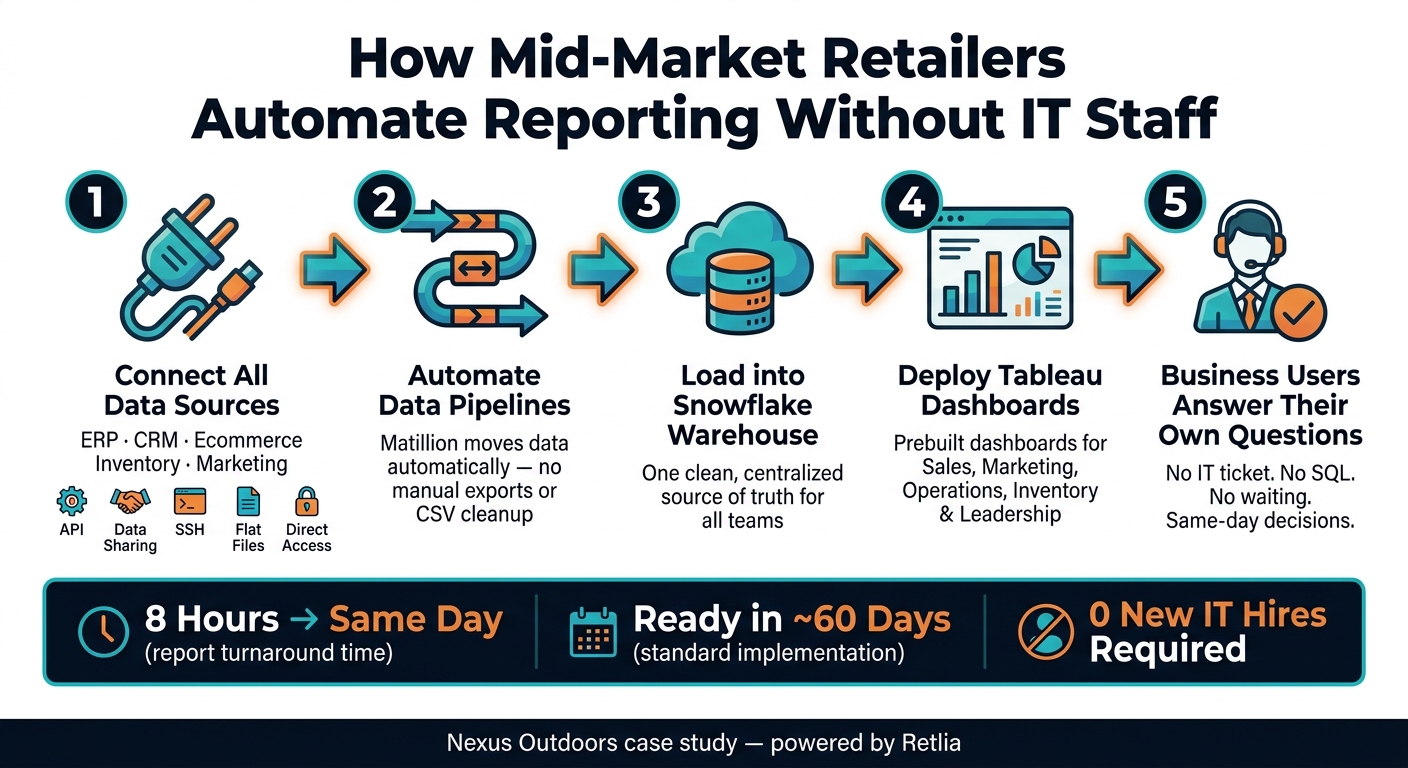
How Mid-Market Retailers Automate Reporting Without IT Staff
Nexus Outdoors fixed reporting by changing the system behind it, not by adding more people. Instead of hiring IT staff or analysts, the company set up a self-service model that made data easier to access and use. You can see that shift in three places: how data moves, who can work with it, and how fast teams get answers.
Two Myths Aaron Says Nexus Disproved
Those myths mattered because Nexus needed enterprise-level reporting without enterprise staffing. Aaron pushed back on both:
"The first myth is that you need an internal IT department to have a data warehouse. Well, I’m here to say, I was part of a company, had a large team, and that’s great, but we here at Nexus Outdoors do not have an IT department that has to support our data warehouse. So you can do it without an internal IT team."
"The second thing that I was convinced we needed is I thought we needed a in-house data analyst. And I will tell you through the journey of this project, I also busted that myth, which is we have multiple employees here that we have data at their fingertips and they’ve been educated enough where they can be dangerous."
His point is pretty clear: a company doesn’t need a big internal data team to build a working reporting setup. Nexus showed that a lean team can still give people access to the numbers they need.
What the Day-to-Day Operating Model Looked Like
Retlia automated data pipelines through Matillion, loaded a Snowflake warehouse, and surfaced data in Tableau dashboards for business users. Data from ERP, CRM, ecommerce, inventory, and marketing systems flowed in automatically.
Retlia also connects through API, data sharing, direct access, SSH, and flat files. That gave Nexus a setup that could pull data from different parts of the business without a lot of manual work. The bigger shift, though, wasn’t just the stack. It was the fact that data was no longer stuck with technical staff.
Self-Service Access for Non-Technical Teams
Business users no longer had to sit in an IT queue and wait for someone else to pull a report. Aaron explained how that change played out across the team:
"Some, I would say non-power users, if you will, have broadened their perspective and they’re doing things today that the power users were doing right off the shelf."
That meant non-technical team members could run standard reports and answer day-to-day questions on their own. And when that happens, reporting stops being a bottleneck and starts acting like what it should be: a tool people can use when they need it.
What Changed After Data Became Easy to Access
Once Nexus made reporting self-service, the shift showed up in everyday work almost right away.
Teams Stopped Avoiding Deeper Analysis When Reporting Was No Longer a Project
Before that change, manual reporting made people sidestep harder questions. If getting an answer meant building a report from scratch, many teams simply didn’t go there. They spent more time putting reports together than using them to make decisions.
Aaron described that dynamic directly:
"Pre-data at our fingertips, you’d look at that mountain and you’d say, we’re not even going to start the hike." – Aaron Ambur, President, Nexus Outdoors
That changed more than turnaround time. It changed the kinds of questions teams felt ready to ask. When reporting stopped feeling like a heavy lift, deeper analysis became part of the normal workflow instead of a separate project.
Faster Decisions Across Sales, Marketing, Operations, and Leadership
Questions that once sat in a backlog started turning into same-day decisions. As Aaron put it:
"Now there’s never a day that we hesitate to try to answer… a business question." – Aaron Ambur, President, Nexus Outdoors
Sales, marketing, logistics, and operations worked from the same data instead of waiting on separate reporting cycles. That meant more people could answer their own questions, and the reporting queue stopped becoming a bottleneck.
For mid-market retailers, that’s the big takeaway: when data is easy to get, decision-making changes across the business.
How Mid-Market Retailers Can Follow This Model With Retlia
Nexus Outdoors showed that a mid-market retailer can automate reporting without adding IT or analyst headcount.
Retlia takes that same model and makes it easier to roll out across mid-market retail teams. It gives retailers a single warehouse and BI layer for ERP, CRM, ecommerce, inventory, and marketing data. It also supports connectors for Shopify, Amazon, NetSuite, Microsoft Dynamics, API, data sharing, direct access, SSH, and flat files. So instead of bouncing between manual exports, spreadsheet cleanup, and IT tickets, teams can work from one place.
Because the data layer is standardized, setup stays fast. Retlia’s standard implementation is production-ready in about 60 days, including data warehouse installation, pipeline setup, data cleaning, and dashboards shaped around your team. Put simply, that’s faster than building the same thing in-house from scratch.
Sales, marketing, operations, and inventory teams can also run ad hoc analysis using current data without waiting on IT. With prebuilt dashboards and self-service tools, non-technical users can answer day-to-day questions without SQL or coding. That means teams can go from reporting to action on the same day.
If your team still depends on manual reporting, contact Retlia to automate the data layer and give business users direct access to current data – without adding headcount.
FAQs
What kind of retailer is this model best suited for?
It’s a strong fit for mid-market retailers that need faster reporting and broader access to data, but don’t want to add IT staff or analyst headcount.
Nexus Outdoors is a good example. In its sub-$100M case, manual Excel reporting slowed teams down until the company switched to self-service analytics without expanding IT. As Aaron Ambur said, “Everyone has data, but not many people have information,” and “now there’s never a day that we hesitate to try to answer… a business question.”
How much internal technical work is needed after setup?
Very little. Retailers can automate reporting and give more teams access to data without adding IT analysts by using a retail data platform that brings sources together and supports self-serve dashboards and metrics.
At Nexus Outdoors, slow Excel-based reporting was replaced with automated, self-serve visibility. Aaron Ambur said, “Everyone has data, but not many people have information,” and that they could do it “without an internal IT team” and without an in-house analyst.
How do non-technical teams learn to use data confidently?
At Nexus Outdoors, simple reporting used to get bogged down by manual spreadsheets and IT bottlenecks. Even basic questions could take too long to answer. Aaron Ambur summed up the problem well: “Everyone has data, but not many people have information.”
After moving to a self-service retail data platform, Nexus changed that dynamic. Non-technical teams could get real-time access to dashboards and run ad hoc analysis on their own, without adding IT staff or analysts. The shift made day-to-day decision-making much easier. In Ambur’s words, “Now there’s never a day that we hesitate to try to answer… a business question.”
