

I wouldn’t launch a loyalty program until a small pilot shows it adds margin – not just repeat purchases. In this article’s hypothetical model, moving from 30% to 80% redemption increases reward costs from $3,600 to $9,600, with no added sales.
My prelaunch checklist:
- Test the costs: Model heavy redemption, returns, coupon stacking, and rewards customers never use.
- Close rule gaps: Limit bonuses, review duplicate accounts, and reverse points on returned purchases.
- Connect the data: Link customer, purchase, reward, and cost records so discounts don’t hide losses.
- Set stop rules: Cap spending and reward obligations, measure added purchases against a comparison group, and name who can pause offers.
<u>More redemptions don’t prove the program works.</u> I’d expand only when margins hold, reports are current, and the team has a written plan for problems.
Petco’s Relaunch: Redemptions Exceeded Forecasts
Easier Redemption Led to Unexpected Sales Costs
In late June 2026, Petco Perks members earned 10 points per $1 on most products and 30 points per $1 on private-label brands, while redeeming 1,000 points for $1 off. That made product mix an important part of the program’s economics.[1][4][3]
Petco added post-launch controls to slow redemptions.[1] That is why first-launch economics need stress testing before rollout.
Petco reported a sales hit, not a disclosed profit loss; the profit impact depends on margins, incremental purchases, and operating costs.[1][2]
Regional Retailers Need Room for Unexpected Costs
Regional retailers have less room to absorb rising reward costs. Before launch, model conservative, expected, and high-redemption scenarios. Compare immediate and delayed redemption, factor in product-level margins, and spell out how returns, cancellations, and coupon stacking affect points.
Set a reward-cost ceiling that leaves enough money for planned inventory purchases and operating expenses. Separate purchases customers would have made anyway from those driven by the reward. Can your data flag those costs before they spiral?
sbb-itb-03d92ea
Where a First Loyalty Program Can Go Wrong
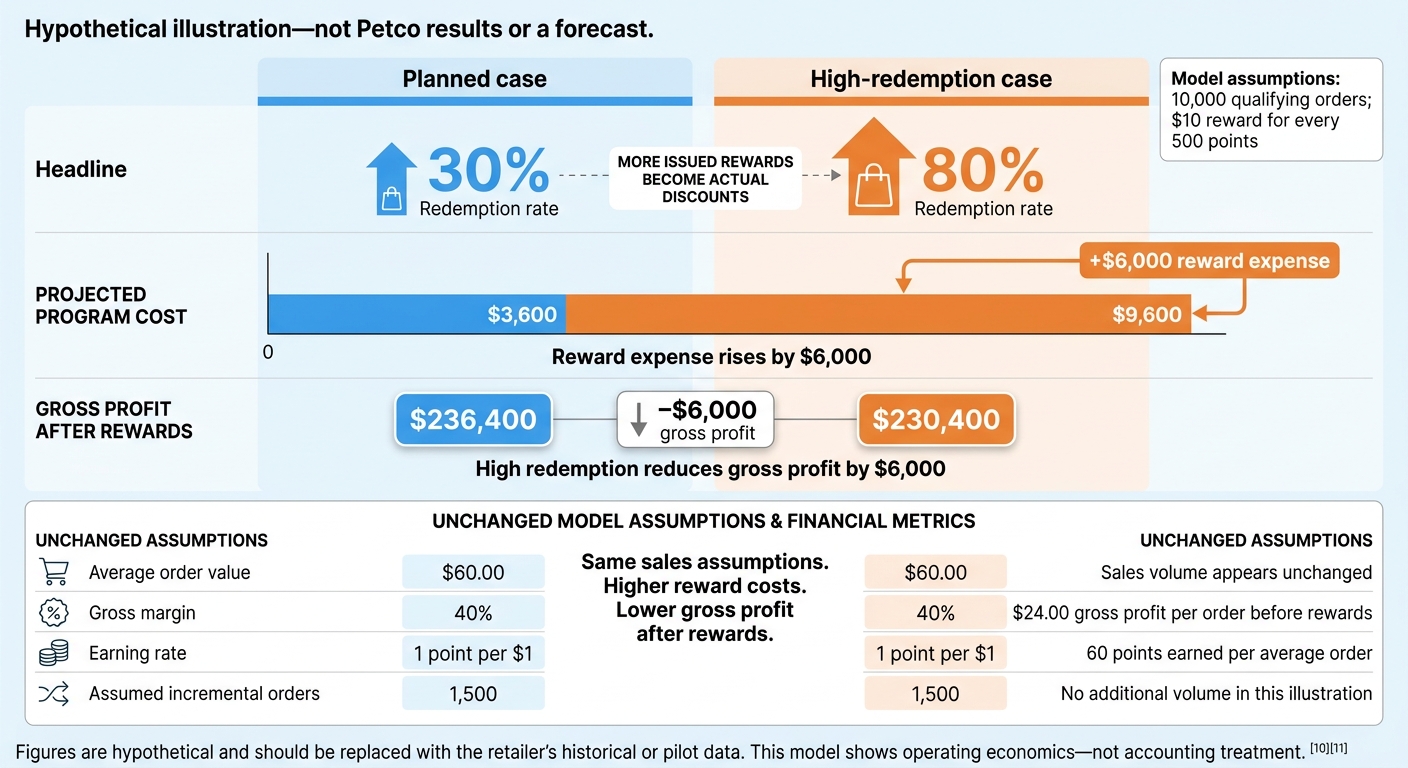
Loyalty Program Costs: Planned vs. High Redemption
Reward Costs Can Exceed Added Sales
Reward costs climb when redemptions outpace added sales. Earning rates and reward values set the discount promised. Redemption rates and timing determine how much customers use and when. Unused rewards, or breakage, lower expected costs, but retailers need data to support those assumptions. Low-margin purchases and returns can also cut into profit. The program then becomes a discount engine rather than a growth engine.
The illustrative model below assumes 10,000 qualifying orders and a $10 reward for every 500 points. Figures are hypothetical and should be replaced with the retailer’s historical or pilot data.[5][6]
Metric Planned case High-redemption case Financial consequence Average order value $60.00 $60.00 Sales volume appears unchanged Gross margin 40% 40% $24.00 gross profit per order before rewards Earning rate 1 point per $1 1 point per $1 60 points earned per average order Redemption rate 30% 80% More issued rewards become actual discounts Projected program cost $3,600 $9,600 Reward expense rises by $6,000 Assumed incremental orders 1,500 1,500 No additional volume in this illustration Gross profit after rewards $236,400 $230,400 High redemption reduces gross profit by $6,000
The same sales can leave very different profits after rewards. Higher redemption could help if it increases order size or brings back customers who would otherwise leave. But if it only discounts purchases customers already planned to make, it eats into margin. Redemption rate can tip a launch from profit to loss.[5][6]
If reward costs are material, finance needs to track them from day one. This table shows operating economics – not accounting treatment.
Treat unredeemed points, credits, or vouchers as a liability. Reconcile the loyalty ledger with the general ledger, and update breakage assumptions as actual redemption changes.[5][6][8]
Loose Rules Leave Room for Reward Abuse
Verify email addresses or phone numbers. Limit sign-up, referral, birthday, and promotional bonuses, and check for duplicate identities without blocking legitimate household accounts.
Set earning and redemption limits, spell out which coupons customers can combine, and publish eligibility rules for gift cards, taxes, shipping, clearance merchandise, and low-margin products. Reverse points after cancellations or returns, and have a policy for rewards customers have already spent.
Require stronger authentication for sensitive account changes and large redemptions to reduce account-takeover risk. Log employee adjustments with an approving manager. Send suspicious activity to a review queue with clear thresholds, a named escalation owner, temporary holds, and a way for customers to appeal.[10][11][12][13]
Disconnected Data Can Hide Poor Results
Even tight rules can fall short when separate systems hide the margin impact. Disconnected POS, ecommerce, ERP, CRM, marketing, and loyalty data can count shoppers twice or miss returns and fulfillment costs. That skews repeat-purchase rates, purchase frequency, average order value, customer retention, and contribution margin.
Use a single customer ID, transaction timestamp, and return link in a unified data warehouse to measure margin after rewards. Reports should answer one question: Did the loyalty program add margin after rewards, shipping, fulfillment, returns, and fraud – not just member sales?
Where possible, test behavior against a randomized pilot holdout. Otherwise, use comparable baseline cohorts matched on prior spending, visit frequency, channel, geography, product mix, and recency. Set the measurement window before launch, leaving time for both earning and redemption. Comparing members with nonmembers overstates lift because members often shop more to begin with.[7][9]
Use Unified Data to Plan a Controlled Launch
Once the measurement plan is set, use the warehouse to keep the launch within approved limits.
Link Loyalty Records to Customers and Margins
Build certified warehouse tables that connect customers, households, transactions, products, prices, costs, promotions, channels, returns, marketing touches, and loyalty events. Assign persistent customer and household IDs so a shopper isn’t counted twice across emails, phones, cards, or devices.
Link rewards earned, redeemed, expired, and reversed to their orders and cost basis. Finance should approve definitions and reconcile reward balances before scale-up. These connections let teams measure whether loyalty adds margin.
Use Retlia’s 360° customer analysis and self-service BI to give authorized teams access to purchase history, offers, returns, and reward balances – without rebuilding spreadsheets or requesting custom SQL for every question. IT should manage matching rules, role-based access, masking, retention, and consent rules. Keep executive reporting aggregated when customer details aren’t needed.
This setup also makes pilot limits easier to enforce.
Set Limits and Run a Small Pilot
With the data model in place, turn the economics into firm launch limits. Before the pilot starts, approve a reward-cost ceiling, margin floor, and liability limit. Document product exclusions, stacking rules, redemption caps, and approval thresholds.
Run the pilot in selected stores or customer cohorts to contain unexpected reward costs. Leave enough time to track both earning and redemption.
Decide how to respond before problems appear. Suspicious balances should trigger account reviews. Breached cost limits should trigger offer pauses. Weaker margins should trigger a review of future earning terms. Require approval before expansion, based on results against the pilot thresholds.
Marketing owns customer communications, operations owns store and support training, and IT owns integration reliability. Explain changes clearly, and distinguish changes to future earning terms from rewards already promised.
Track Costs, Customer Behavior, and Risk
Once the pilot starts, monitor the same rules and metrics daily. Use Retlia’s Retail KPI Dashboard to label delayed feeds clearly so teams don’t treat stale totals as current. Finance should approve consistent denominators and measurement windows.
Review exceptions daily. Meet weekly to decide whether to continue, adjust, pause, or expand, based on margin after rewards, returns, and fraud.
| Metric | Calculation | Business question | Owner | Review frequency |
|---|---|---|---|---|
| Reward cost as a percentage of sales | Redeemed reward value ÷ eligible net sales × 100 | Are discounts within budget? | Finance | Daily exceptions; weekly review |
| Contribution margin after rewards | Net sales − COGS − variable costs − rewards | Is the program profitable? | Finance | Weekly |
| Outstanding reward obligations | Earned, unredeemed reward value adjusted for expected expiration and reversals | Is future cost within the liability limit? | Finance and data | Daily |
| Repeat-purchase rate | Members with at least two qualifying purchases in the window ÷ purchasing members | Are return visits supporting expansion? | Marketing | Weekly and monthly |
| Redemption rate | Rewards redeemed ÷ rewards issued, using a stated value or unit basis | Are redemptions within forecast? | Finance and marketing | Daily exceptions; weekly |
| Return-linked rewards | Reward value earned or retained on returned or canceled orders ÷ total reward value | Are returns creating leakage? | Operations and finance | Daily exceptions; weekly |
| Duplicate-account rate | Suspected duplicate accounts ÷ total active accounts | Is identity quality creating waste or fraud risk? | IT and data | Daily exceptions; weekly |
| Reporting delay | Time from source transaction to certified dashboard record | Is the data current enough to approve expansion? | IT and data | Daily |
Conclusion: Check the Economics Before Launch
Once pilot metrics are available, treat final approval as a go/no-go decision – not a launch-date formality. Approve only if stress-case costs leave a positive margin after accounting for faster redemption, breakage, returns, and abuse.
Before full rollout, test partial returns, exchanges, cross-channel returns, and coupon stacking.
Finance must quantify obligations. Marketing must show incremental lift using a valid comparison group. Executives need current cost, liability, and margin data, while employees need clear rules for earning, redemption, and exceptions.
No written intervention plan, no full launch. Specify who can pause offers, approve changes, and communicate with customers. If any check fails, keep the pilot capped until the issue is fixed.
Scale easier redemption only when the economics work, the rules hold, and reporting is timely. Retlia provides the unified data warehouse and BI layer; your team makes the go/no-go call.
FAQs
How long should my loyalty pilot run?
The provided information doesn’t set a fixed pilot duration. A retail data warehouse typically takes about 60 days to launch, but that’s not the same as how long the pilot runs.
Before the pilot starts, clean, unify, and fully integrate your customer and transaction data to help prevent margin erosion and duplicate accounts. Once the warehouse is live, use your loyalty dashboard to track retention and margins and assess performance.
How do I set a sustainable reward rate?
Build your program on clean, unified customer and transaction data. Weigh short-term incentives – typically 10% to 15% of margin – against long-term customer lifetime value.
Bring POS, e-commerce, and loyalty records together in a retail data warehouse. Then compare program costs with incremental revenue. Track reward redemption, breakage (unredeemed rewards), and campaign lift to check whether rewards keep customers coming back profitably or eat into margins.
How can I reduce rewards without losing customer trust?
Replace blanket discounts with targeted offers backed by data. Bring customer and transaction data into one retail data warehouse, then group members by purchase frequency, category preferences, and spending levels.
Use that data to spot high-value customers and those at risk of leaving. Tailor win-back campaigns or offer exclusive perks that customers care about – without eating into your margins. Build your loyalty plan around measured incremental gains, not guesswork.
