

If your mid-market/regional retail team still runs key decisions through spreadsheets, you’re probably losing time, margin, and trust in the numbers.
I’d sum the article up like this: midmarket and regional chains usually don’t need a huge enterprise data program. They need one clean data setup that pulls in POS, ERP, ecommerce, CRM, and marketing data, then turns it into shared KPIs, retail KPI dashboards, self-serve reporting, and clean customer records. In this article, I’d also call out the cost range right away: about $1,000 to $3,000 per month, with setup in around 60 days.
Here’s the short version:
- The main problem: too many systems, too many spreadsheets, and too many mismatched reports
- Who gets hit: sales, marketing, store teams, merch, supply chain, and leadership
- What it costs: slower decisions, weaker vendor talks, missed demand shifts, and loyalty waste
- What retail teams need: one warehouse, shared KPI rules, and reporting people can use without IT for every question
- What clean data also supports: loyalty measurement, customer profiles, and AI tools people will actually use
A few facts from the article stand out:
- Pricing is listed at $1,000–$3,000/month
- Setup is listed at ~60 days
- The core system connects 5 main data sources: ERP, POS, ecommerce, CRM, and marketing
- The article points to 4 day-to-day needs: dashboards, self-service reporting, identity matching, and clean data for loyalty and AI
| Issue | What happens |
|---|---|
| Separate systems | Teams get different answers |
| Old reports and flat files | Reporting slows down |
| No shared KPI rules | Meetings turn into number debates |
| Bad customer data | Loyalty and AI outputs fall apart |
| No direct user access | IT becomes the bottleneck |
My take: this article is about moving from report chaos to one shared view of the business without paying enterprise-level costs. That means fewer spreadsheet checks, faster calls, and a better shot at protecting margin as store count, channels, and data volume grow.
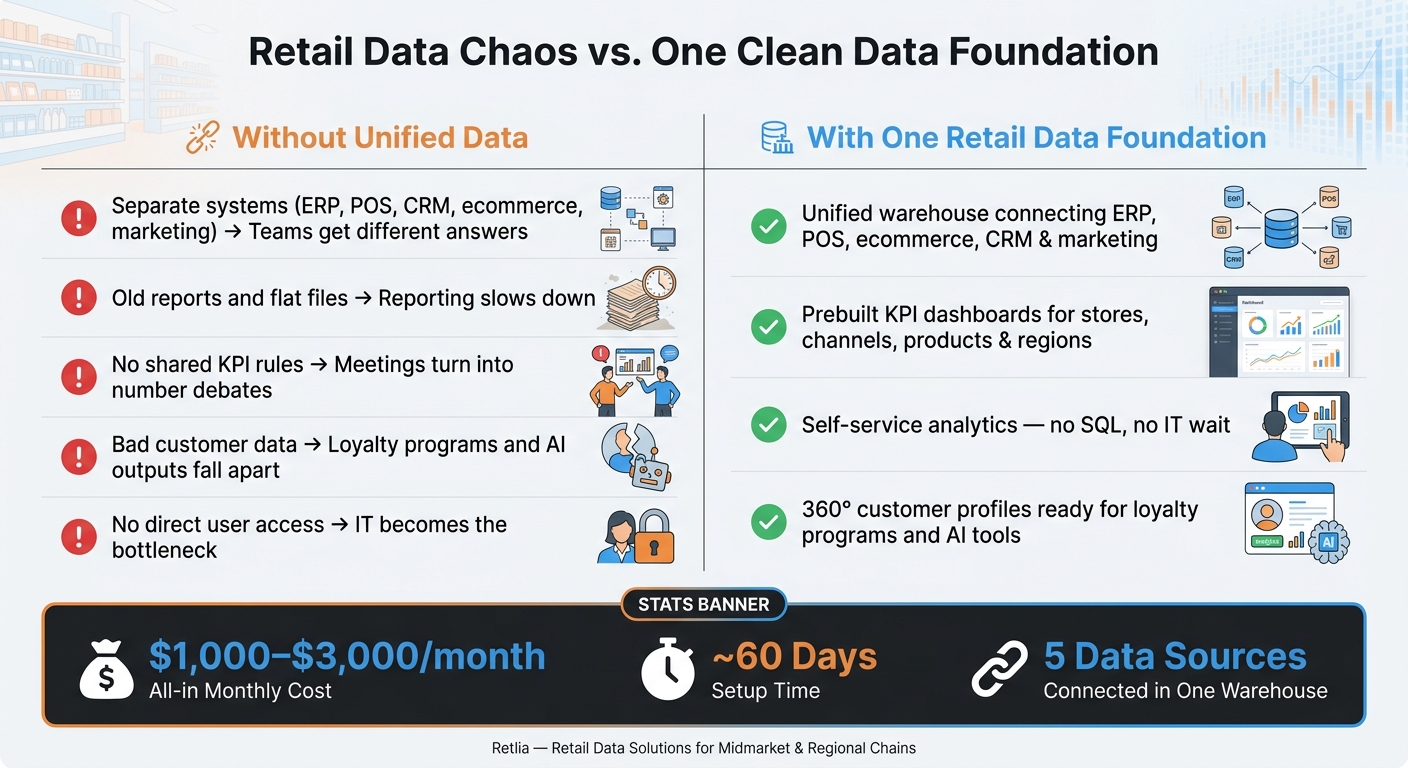
Retail Data Chaos vs. Unified Data Foundation: What Midmarket Chains Gain
The Opportunity for Mid-Market Retailers | Thomas Lichtwerch
sbb-itb-03d92ea
Why Midmarket and Regional Chains Hit a Data Wall
System complexity is where many midmarket and regional retailers hit the wall. You’ve added stores, channels, and staff. Your systems grew right along with the business. But your ability to get clean, reliable answers from that data often didn’t grow at the same pace.
You Have a Serious Retail Tech Stack, but No Dedicated Data Team
Most midmarket and regional chains run a mix of POS, ERP, ecommerce, CRM, marketing, and legacy systems. Each one holds part of the story. The trouble is, they don’t connect cleanly.
This usually isn’t about bad tools. It’s about integration and interpretation. Unifying multiple data sources into one reliable view takes dedicated data skills, and that gap shows up fast. Once data is spread across too many places, another issue kicks in: each team starts working from a different version of the truth.
Every Department Needs Data, and Conflicting Numbers Slow Decisions
Sales, marketing, operations, supply chain, merchandising, store leaders, and executives all need the same numbers. But when each team pulls data from its own system or spreadsheet, you end up with different answers to the same question.
That’s where things bog down. Decisions slow. Trust drops. Then usage drops too.
The result is a business full of smart people making calls based on mismatched reports. These common retail data problems often stem from fragmented infrastructure.
These pressures show up across every team that depends on the same numbers.
Legacy Systems and Competing IT Priorities Keep Data Work Stuck
Regional chains also deal with legacy systems, legacy reports, and flat files. That data still matters. But IT teams are already stretched thin, so data work keeps getting pushed back while other priorities jump the line.
The fallout is pretty direct: slower reporting, delayed fixes, and stalled data projects.
And when those systems stay disconnected, the business pays for it in margin, speed, and growth.
What Fragmented Retail Data Costs Your Business
Fragmented retail data costs more than reporting time. It chips away at margin, slows decisions, and keeps growth opportunities out of sight. At first, the cracks show up in reporting. Then they spread into pricing, purchasing, and customer programs.
You Need Enterprise-Grade Dashboards Without Enterprise-Level Spend
Store leaders, merchandisers, and executives need a clear view of performance across locations, channels, and product lines without waiting on delayed reports. That sounds simple. In practice, it’s not.
The hard part is finding retail data solutions that can scale without piling on extra complexity or blowing up the budget.
Midmarket and regional chains need reporting across stores, channels, products, and customers without enterprise cost or heavy setup. When they don’t have that, teams get stuck in spreadsheets and disconnected reports. And that same reporting gap doesn’t stop there. It also hurts vendor leverage and slows regional decisions.
Weak Data Hurts Vendor Negotiations, Regional Growth, and Margin
Incomplete data doesn’t just make reporting harder. It weakens your hand in vendor negotiations.
If you can’t clearly show sell-through, regional demand, and category trends, you’re walking into those conversations without the proof you need. That’s a tough spot to be in.
The same gap slows pricing, assortment, and channel mix decisions. If your regional demand data is split between a POS system, a spreadsheet, and an ERP that doesn’t connect with your ecommerce platform, you’re less likely to spot trends in time to do anything useful with them. Unified data gives buyers, planners, and operators the facts they need to negotiate better, move faster, and act on regional demand.
That same data base also decides whether loyalty and AI can work at all.
Loyalty Programs and AI Tools Both Break on Messy Data
Loyalty and AI both fall apart without clean customer and transaction data. A loyalty program built on duplicate accounts and uneven purchase history rewards the wrong customers and eats into margin. Unified customer identity and clean transaction history aren’t nice extras – they’re the starting point for a loyalty program that drives incremental revenue instead of just adding cost.
The same goes for AI assistants and chatbots built on your business data. If the source data is inconsistent or uncontrolled, employees won’t trust the output, and the project stalls. Whether you’re trying to make loyalty work or roll out AI, it starts in the same place: one clean, connected source of truth across your systems.
What a Midmarket Retail Data Solution Should Include
These problems all point to the same fix: one retail data foundation built for midmarket scale. It needs enterprise-grade reporting, but without the overhead that usually comes with big-company systems.
For growing retail teams, that matters a lot. Most need strong analytics, but they don’t have a big data engineering team sitting in the background. At a minimum, this foundation should do three things well:
- Unify data
- Standardize KPIs
- Give business users direct access
A Retail Data Warehouse That Connects ERP, POS, Ecommerce, CRM, and Marketing
ERP, POS, ecommerce, CRM, and marketing platforms each hold one piece of the picture. A retail warehouse pulls those pieces into one governed model.
A retail data warehouse with a custom schema brings current and legacy data into one place and standardizes definitions. So when someone says "net sales," it means the same thing across stores, channels, and regions. That makes current and legacy data usable together, and it keeps weekly meetings focused on action instead of debates over definitions.
Prebuilt KPI Dashboards to Compare Stores, Channels, Products, and Regions
Once the data model is unified, the next job is to define the metrics every team uses. Most midmarket retailers don’t need custom dashboards built from scratch. They need trusted KPIs like net sales, gross margin, returns, category performance, retention, channel mix, and regional comparisons.
Prebuilt retail KPI dashboards give store leaders, merchandisers, buyers, and executives the same numbers on the same schedule, without waiting around for reports.
Self-Service Analytics and 360 Customer Profiles Business Users Can Trust
After core KPIs are set, business users need a way to dig into the numbers on their own. They shouldn’t have to wait on IT every time they want to answer a new question.
Self-service analytics let marketing, ops, and category teams build their own reports without SQL or version conflicts.
At the customer level, identity-matched 360° customer profiles give every team one accurate view of each customer across store, online, and loyalty activity. That means one customer record teams can trust for reporting, segmentation, and automation.
How Retlia Addresses the Core Midmarket Retail Use Cases
Retlia turns that base into three practical results: lean reporting, profitable loyalty, and customer data that’s ready for AI.
Move Past Basic Reporting Without Enterprise Overhead
Retlia gives midsize and regional chains enterprise-grade warehousing, dashboards, and analytics for about $1,000 to $3,000 per month, with setup in about 60 days. The big draw is simple: you get the kind of reporting stack larger retailers use, without adding headcount or signing up for a multi-year build.
Once the warehouse is live, that same clean data can support loyalty programs and AI use cases too.
Launch Profitable Loyalty and Get Your Data Ready for AI Tools
When customer and transaction data live in one place, Retlia can help teams measure incremental lift, retention, and margin by segment. The retail loyalty program dashboard shows whether the program is actually improving retention and margin.
That same clean warehouse data can also power internal assistants, chatbots, and agents for store leaders, buyers, and operators. So instead of treating AI like a shiny add-on, teams can use data they already trust.
Use the KPIs and Reporting Patterns That Strong Retailers Your Size Already Track
Retlia also gives teams a practical starting point for the metrics peers at this size already track. Its KPI library is built around what midsize and regional retailers tend to watch closely: margin pressure, retention, channel mix, and store, channel, and product performance.
The retail KPI dashboard portfolio gives leaders a concrete look at how those metrics show up across stores, channels, customer behavior, and product performance.
Conclusion: One Clean Retail Data Foundation for Growth, Margin, and Faster Decisions
All of those use cases lead to the same thing: one retail data foundation that can grow with the business without dragging in big-company IT baggage.
Midmarket and regional chains don’t need a giant IT redo to get dependable retail analytics. They need a governed retail data warehouse that pulls ERP, POS, ecommerce, CRM, and marketing data into one source of truth. Then it needs to put that data in a form people can use every day, not just stare at.
For teams that have outgrown spreadsheet reporting but don’t have a large data team, that setup needs to handle four jobs well:
- Trusted dashboards
- Self-service reporting
- Customer identity matching
- Clean data for loyalty and AI
When data is unified, teams spend less time matching numbers across reports and more time doing something with them. That means less time chasing down discrepancies, faster decisions, stronger vendor leverage, and better regional planning. It also gives teams a clear way to focus on the KPIs that matter most across stores, channels, products, and regions.
Retlia fits this stage of growth: a retail data warehouse and BI setup built for midmarket teams, set up in about 60 days and priced at around $1,000 to $3,000 per month. For midmarket and regional retailers, that kind of foundation helps support growth, protect margin, and remove reporting bottlenecks.
FAQs
How do I know if we’ve outgrown spreadsheets?
You’ve likely outgrown spreadsheets when manual work, old systems, and disconnected data make it hard to get reliable answers without a lot of effort.
Retlia helps midmarket and regional retailers bring CRM, ERP, and e-commerce data into a managed warehouse. That gives teams across the business self-service analytics, sharper purchasing insight, profitable loyalty tracking, cleaner data for AI, and better benchmarking and customer profiles.
What should a retail data setup include?
For midmarket and regional retailers, a retail data setup should pull data from systems like CRM, ERP, and e-commerce into one clean, reliable source.
It should also include dashboards and analytics, self-service reporting for teams across the business, customer identity matching, and a data base that supports loyalty programs, AI use cases, and better decisions across operations, sales, marketing, supply chain, and stores.
How can clean data improve loyalty and AI?
Clean, unified data helps midmarket and regional retailers get more from loyalty programs and use AI with business data they can trust. It brings together disconnected CRM, ERP, and e-commerce systems, so teams can work faster with self-service analytics.
Retlia helps by providing:
- Dashboards to compare stores, channels, and products
- A schema to unify core retail data
- Customer identity matching and profiling for loyalty and AI