

If your sales data across wholesale and ecomm lives in five systems, you do not have one sales number. You have five partial views, extra spreadsheet work, and margin reports that do not match.
I’d sum it up like this: if you want one view of revenue, margin, customers, products, and channels, I need to pull wholesale, ecommerce, marketplace, CRM, and POS data into a retail-focused warehouse instead of forcing reports out of ERP, CRM, or spreadsheets.
Here’s the short version:
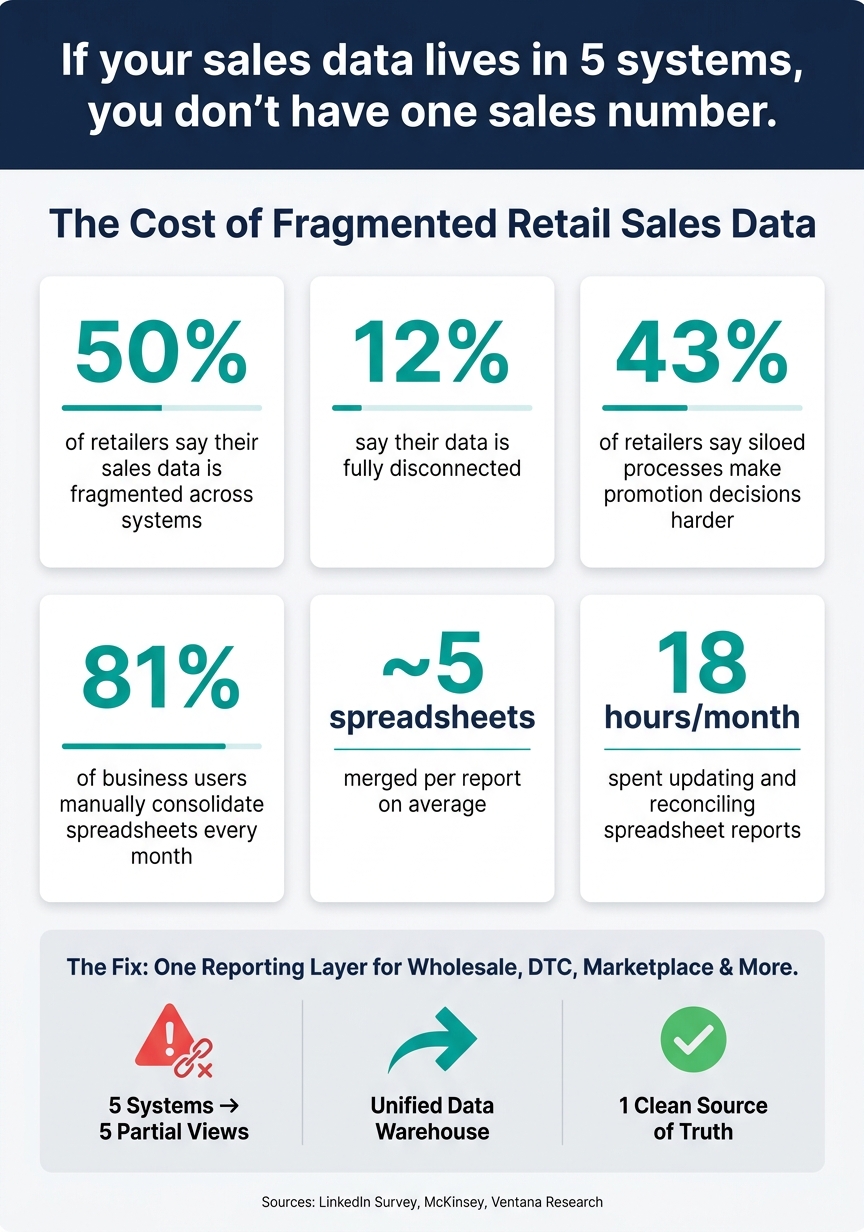
- 50% of retailers say their data is fragmented, and 12% say it is fully disconnected
- 43% of retailers say siloed processes make promotion decisions harder
- 81% of business users still merge about five spreadsheets and spend 18 hours per month updating them
- The core problem is simple: the same sale is stored differently across systems
- The fix is simple too: create one reporting layer that standardizes customers, products, orders, invoices, and channels
What this means for me in practice:
- I can stop matching SKUs and customer names by hand
- I can compare wholesale vs. DTC vs. Amazon in one place
- I can see net margin by channel, product, and account
- I can give teams self-serve dashboards instead of CSV exports
- I can keep transaction systems focused on day-to-day processing, while the warehouse handles reporting
A setup like Retlia is built for this model: connect source systems, clean records, map them into one sales structure, and deliver reporting without a full in-house data team. The article’s point is straightforward: unified sales reporting starts with a warehouse, not with more spreadsheet cleanup.
Fragmented Retail Sales Data: The Hidden Cost of Disconnected Systems
Why wholesale and ecommerce sales data stay disconnected
Most midsize commerce businesses don’t end up with fragmented data overnight. It happens bit by bit, one system at a time. They add an ERP for wholesale, an ecommerce platform for DTC, a CRM for accounts, and marketplace portals for Amazon or Walmart. Each one makes sense on its own. The trouble starts when those systems define the same sale in different ways.
A LinkedIn-reported survey found that 50% of retailers say their data is fragmented, and 12% say it is fully disconnected. That leaves many teams making pricing, inventory, and channel calls with only part of the story[2].
Different systems record the same sale in different ways
The main problem isn’t just having a lot of tools; it’s the common retail data problems that arise from how they interact. It’s that each tool was built for its own job, with its own logic and data model. Your ERP records a wholesale order as an invoice tied to payment terms, ship dates, and GL accounts. Your ecommerce platform records a DTC sale as a checkout event tied to a customer email, a promo code, and a payment authorization. A marketplace like Amazon uses its own order ID, its own listing ID, and platform fees that don’t line up neatly with your internal cost structure.
That mismatch shows up fast in day-to-day reporting. A retailer might appear as "ABC Retail LLC" in ERP, "ABC Retail" in CRM, and "ABC_Retail_Store" in a marketplace account. The same product might be 12345-BLK-M in ecommerce, P12345M in ERP, and B01XYZ1234 on Amazon. So when someone tries to pull total units sold across channels, analysts have to map those codes by hand. Miss one match, and sales get undercounted or duplicated.
Discounts make the mess even bigger. A trade show deal might sit in CRM notes and later appear as a manual price adjustment on an ERP invoice. That same product could also have a coupon code tracked only in ecommerce. Then finance looks at Q2 discounts by product, sales looks at the same period, and both teams come back with different numbers because each team is looking at a different slice of the data.
Once records stop lining up, every channel report turns into a reconciliation exercise.
Leaders need one view of sales, not five partial views
As these structural gaps pile up, the impact gets very concrete. Decisions slow down because teams argue over revenue numbers. Reporting cycles drag on because analysts are still exporting CSVs, cleaning files, and matching figures before they can even start the actual analysis.
The hard questions are the ones leaders care about most:
- What is the true margin by channel?
- Which customers matter most across wholesale, DTC, and marketplaces?
- How do promotions affect wholesale reorders?
Without one unified data layer, every answer takes manual work, and that doesn’t scale. McKinsey research says 43% of retailers report that siloed processes make it harder to share data and make promotion decisions across teams[1].
That’s why businesses eventually need one warehouse-ready view of sales, not more manual cleanup. This requires a clear strategy on how to unify multiple data sources to ensure accuracy across all channels.
sbb-itb-03d92ea
Why common fixes stop working as the business grows
These teams are doing the work. The issue is simpler than it looks: they’re leaning on operational systems to do a reporting job those systems were never built to do. That’s why these fixes can support day-to-day work, yet still fall apart when the business needs one clear view across channels.
Forcing data into ERP, CRM, or an ecommerce platform creates rigid reporting
ERP systems are built to keep financial records accurate, process invoices, and manage inventory workflows. CRM platforms are built to track relationships, activities, and sales pipelines. Neither one was made to answer questions like net margin by channel this quarter or which accounts are most profitable across wholesale and DTC combined.
When ecommerce data gets forced into ERP or CRM, a lot of the context gets flattened. Report changes start needing IT support. And cross-channel margin is still tough to model.
The reverse creates its own mess. Pushing ERP or CRM data into an ecommerce platform loads that platform with wholesale contracts, offline orders, and complex pricing structures it was never meant to carry. You end up with an overloaded operational system, uneven data quality, and dashboards that still revolve around web metrics.
The outcome is simple: accurate operations, not flexible reporting.
Wholesale modules inside ecommerce platforms do not meet real analysis needs
Wholesale modules can help capture orders. What they usually don’t do is unify reporting.
They rarely connect customer records across channels. They also struggle to model blended margin across fees, returns, and contract terms. So when leaders ask which wholesale accounts are most profitable once marketplace fees and ecommerce returns are included, the answer usually isn’t sitting in the platform. It often means exporting data and building custom reports somewhere else.
It handles order intake, not cross-channel analytics.
Merging spreadsheets cannot keep up with daily business speed
Spreadsheets can work one time, for one report. After that, things get shaky fast.
- Daily volume breaks manual processes
- File versions start multiplying
- Reports get stale before leaders can trust them
- More channels, more SKUs, and more accounts mean more exports and more cleanup
That leaves teams spending more time maintaining the process than finding insight.
These workarounds can look cheaper than a warehouse at first. But the tradeoff is brittle reporting instead of governed analytics. What the business needs is one warehouse-ready sales layer.
What actually works: a retail-specific data warehouse
The fix isn’t another workaround. It’s a retail-specific data warehouse.
This is a centralized, cloud-based setup built to bring together sales data from ERP, CRM, ecommerce, and marketplace systems. It pulls data from across your commerce stack, cleans it up, standardizes it, and gets it ready for analysis – without asking an operational tool to handle a job it was never meant to do.
Your operational systems keep doing what they do now. The warehouse handles the reporting side.
A data warehouse gives you one clean source of truth
Each system in your stack has its own IDs, naming rules, and data formats. That’s where things get messy fast.
A customer who buys wholesale through your ERP and direct-to-consumer through your ecommerce platform may show up as two different records. A product listed as SKU-1042 in your ERP might appear as SKU-1042-BLU-M in your ecommerce platform.
A warehouse fixes that by matching and standardizing records across systems. It ties wholesale, ecommerce, and marketplace sales back to the same customer, product, and channel records.
So instead of juggling mismatched exports, you get one standard structure for:
- Orders
- Invoices
- Customers
- Products
- Channels
That changes the day-to-day experience in a big way. When a VP of Sales pulls net sales in USD by channel for the month-to-date, they get one number – not five different figures from five different exports.
That’s what makes retail reporting usable at scale.
How Retlia makes data warehousing practical for midsize commerce teams
The next issue is simple: how does a midsize team get a warehouse without building the whole thing from scratch?
That’s where many teams get stuck. Cost is one problem. Build complexity is another. Retlia gives midsize teams a ready warehouse and BI layer built for commerce reporting.
Retlia connects to common commerce systems through APIs, databases, and flat files. It pulls those sources together, standardizes sales data, and delivers retail dashboards and self-service reporting without custom builds.
That’s what makes unified reporting workable in everyday commerce operations.
How Retlia unifies wholesale and ecommerce sales data in practice
Connect source systems and standardize sales data
Retlia doesn’t try to cram ecommerce data into an ERP or shove ERP data into ecommerce. Instead, it brings every source into a single reporting layer.
That includes the systems many midsize teams already use across commerce, ERP, CRM, POS, and marketplaces. Retlia connects through APIs, SFTP, direct database access, and cloud sharing for high-volume sources. It also handles the connectors, warehouse, and BI layer for you.
From there, Retlia maps each order, invoice, and transaction into one sales model, while still keeping the source and channel detail intact.
Clean customer, product, and channel records for reliable reporting
Getting the schema lined up is only one part of the job. The tougher issue is messier: the same customer or product often shows up as multiple records across different systems.
Retlia starts by matching customers through shared IDs or email addresses. Then it uses fuzzy matching and address normalization to merge close variations into one customer record. That makes customer-level reporting usable across wholesale, ecommerce, POS, and marketplaces.
It does the same kind of cleanup for products. SKUs from the ERP, ecommerce variant IDs, and marketplace listings are all mapped to one canonical product ID. Brands and categories are normalized into one hierarchy, so product reporting stays consistent. Channels get plain labels like Wholesale, Shopify, and Amazon US, which makes filtering and comparing much easier for business users who don’t know the source systems inside and out.
Once the data is standardized, the next move is turning it into reporting teams can trust.
What unified sales data changes for the business
Faster channel reporting and clearer margin visibility
Once the data is standardized, reporting gets a lot faster. When wholesale and ecommerce data live in one warehouse, channel reports update on their own. That means far fewer manual exports and much less Excel reconciliation. Instead of rebuilding channel performance in a pivot table, the team can see it in a dashboard right away.
That speed shows up most clearly in margin decisions. When each order includes full cost context, you can see net margin by product, account, and channel without reworking formulas every month. Pricing changes, promo calls, and inventory decisions move faster because the numbers are already lined up.
Self-service analytics for sales, marketing, and ops leaders
It also changes who gets to use the data. With clean, centralized data, leaders can pull their own numbers instead of waiting on an analyst. A sales leader can filter an account dashboard by region, rep, or date range. A marketing leader can check whether a promotion increased ecommerce revenue without cutting into wholesale margin. An ops leader can review fulfillment and inventory performance across channels in one place.
Retlia’s drag-and-drop interface lets most users analyze data without SQL. Role-based dashboards expose fields such as "Net Margin", "Channel", and "Customer Segment", so non-technical users can run their own analysis.
Ventana Research found that 81% of business users manually consolidate about five spreadsheets and spend 18 hours a month updating them.[3]
That time is better spent making decisions, not wrestling with spreadsheets.
Stop forcing reports out of the wrong systems
Once teams can self-serve, it stops making sense to use operational systems as reporting tools. ERP, CRM, and ecommerce platforms are built to process transactions, not to handle cross-channel analysis. Spreadsheets can patch the gap for a while, but they don’t scale. They also create errors and can lead to conflicting numbers, which chips away at trust in planning and reporting.
A data warehouse is the right setup for unified analytics, not a workaround and not a module bolted onto an existing platform. Retlia gives midsize commerce teams that setup at a budget that fits the business: approximately $1,000-$3,000/month, with a 60-day go-live and no need for a full-time data engineering team. The warehouse keeps analysis separate from transaction processing.
FAQs
How does a data warehouse create one sales number across channels?
A data warehouse gives you one sales number by pulling raw, scattered data from your ecommerce platforms, marketplaces, and ERP into one format.
It uses the same rules across metrics like net sales, gross margin, and customer definitions. It also removes duplicates and fixes naming mismatches. The result is one source of truth for every team, without the usual spreadsheet wrangling.
What data sources should be connected for unified sales reporting?
Connect your core retail systems to one centralized data warehouse: POS, ERP, e-commerce platforms, inventory systems, CRM tools, third-party marketplaces, and marketing platforms.
When you bring those sources into one place, it gets much easier to standardize metrics, remove duplicate customer and product records, and build one clean view of sales across every channel.
How long does it take to unify wholesale and ecommerce sales data?
You can bring your wholesale and ecommerce sales data into one live, retail-focused KPI dashboard in 60 days.
That covers your data warehouse setup, data pipeline integrations, retail data cleanup and standardization, plus 100 hours of data engineering and onboarding support so your team can trust the numbers.